
As of June 2026, Safe Superintelligence's valuation is $32 billion — a $2B round closed around April 2025, led by Greenoaks (TechCrunch). Every other number on this page is small or zero: revenue $0, products shipped 0, demos 0, roadmap disclosed: none. That's not a failure — it's the company's entire design, which makes SSI the cleanest natural experiment in what AI capital will pay for belief.
Key takeaways
- Latest mark: $32B (Apr 2025; Greenoaks led; a16z, Lightspeed, DST; Alphabet and Nvidia among backers; Google Cloud supplies TPU compute). ~$3B raised total. No 2026 round reported.
- The product: none until the product is superintelligence — Sutskever, on the record.
- The 2025 stress test: Meta poached co-founder Daniel Gross and reportedly approached SSI about an acquisition — declined. Sutskever became CEO.
- The thesis, in his own framing: AI is entering a "research era" where algorithmic breakthroughs, not compute scaling, drive the next leap.
- Despite shipping nothing, Sutskever is mentioned in 18 of the 1,150+ expert conversations we have analyzed — proof the bet is priced on reputation and discussion, not product.
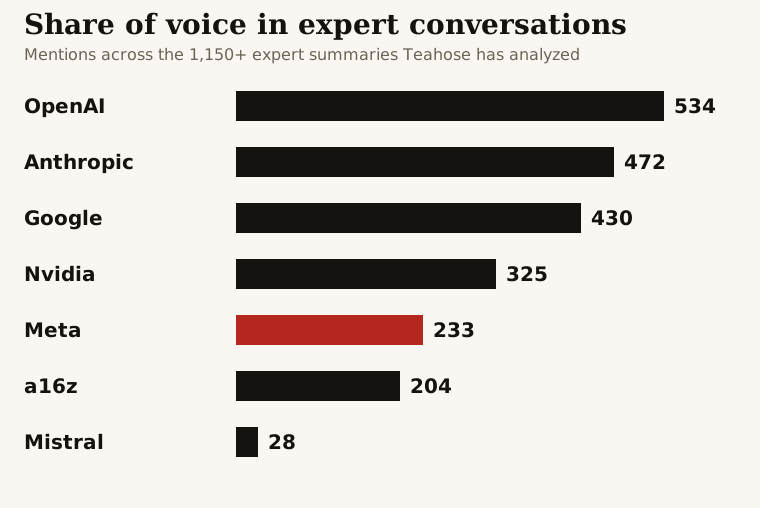
Each bar counts how many of Teahose's 1,150+ expert summaries mention it (word-boundary match across our podcast, newsletter, and paper corpus, June 2026).
Track the field: find the companies most similar to OpenAI and get their latest funding and product signals by email — Teahose Lookalikes.
Mention counts from Teahose's analysis of 1,150+ expert podcast, newsletter & research summaries, June 2026.
Valuation History
| Date | Event | Raised | Valuation |
|---|---|---|---|
| Mar–Apr 2025 | Second round (Greenoaks) | $2B | $32B |
| Sep 2024 | First round (Sequoia, a16z, DST, SV Angel, NFDG) | $1B | $5B |
| Jun 2024 | Founded | — | — |
Sources: $32B — TechCrunch · history — Wikipedia. A 6.4x markup in seven months, on no external evidence — the inverse of every other valuation page we publish, where the revenue does the explaining. (One aggregator claims $6B raised; the verifiable total is ~$3B.)
What $32B Is Pricing
The asset is one thesis and the person most credibly positioned to hold it. Sutskever's view — that the scaling era is giving way to a research era, where the next capability jump comes from ideas rather than another order of magnitude of GPUs — is either correct, in which case a focused lab with no product-serving distractions is exactly the right vehicle, or it's wrong, and $32B bought a beautifully principled research institute.
What 2025 demonstrated is that the asset is liquid in exactly one direction: Meta, unable to buy the company, bought a co-founder. Key-person risk isn't a footnote here; it's the balance sheet. The contrast with every operating lab is the point of comparison — Anthropic at ~21x of $47B run-rate, Mistral monetizing sovereignty, even pre-revenue Physical Intelligence ships models. SSI ships nothing, on purpose, and is worth more than almost all of them.
There is no revenue to watch, so the watchables are people and papers: departures, publications, and any crack in the no-product doctrine.
Latest SSI Signals, Live
SSI Signals
Extracted live from podcasts, newsletters & primary coverage by the Teahose intel pipeline — for a company this quiet, hires and departures are the signal
- 01MENTIONThe founders also helped develop talent that later built Anthropic, OpenAI, SSI, Thinking Machines, and Mistral, making the team unusually influential.AUG 9 · The VC CornerAUG 9
- 02MENTIONCalifornia bans non-competes. Anthropic, SSI, Thinking Machines, and now Discovery Loop all exist partly because their founders could walk out on a Wednesday and incorporate on a TAUG 6 · The AI CornerAUG 6
- 03MENTIONIlya Sutskever... Credited with the foundational insight that undergirds the entire modern AI paradigm... 'Prediction is very close to intelligence.' (said in 2015)MAY 27 · The AI CornerMAY 27
- 04MENTIONIlya Sutskever has publicly stated in a talk that pipeline parallelism should be avoided, a view partially validated by Reiner Pope's analysis.APR 29 · DwarkeshAPR 29
- 05MENTIONI come back to just what Ilya talked about just recently. And what he said was basically, like, with AGI, we almost overshot the target. Humans are not AGI, but we still learn on tAPR 28 · AI + a16zAPR 28
What to Watch Next
- Researcher flow. SSI's only disclosed asset is people; the Meta raid showed the asset moves. Departures are the bear case arriving.
- Any release at all. A paper, a demo, a hint of product would be a doctrine change — and an instant repricing event in either direction.
- The research-era debate. If 2026's biggest gains keep coming from scaling (compute, data), Sutskever's core premise weakens; if algorithmic efficiency wins (the DeepSeek pattern), it strengthens.
Hit Watch on SSI's company profile for new signals by email. Related: Anthropic valuation · Mistral valuation · xAI valuation.
Bottom line: SSI's $32B is not an earnings price but an option price on Ilya Sutskever's research-era thesis — justified only if you believe a focused, product-free lab is the right vehicle for the next capability jump; on conventional metrics, with zero revenue and nothing shipped by design, it is the purest reputation bet in AI.
Editorial figures as of June 11, 2026. The signal feed above updates continuously.
Frequently Asked Questions
What is SSI worth in 2026?
$32 billion — set by a $2B round that closed around April 2025, led by Greenoaks with a16z, Lightspeed, and DST participating; Alphabet and Nvidia are also backers. No new round has been reported as of June 2026, and the company itself discloses essentially nothing. Total raised: about $3B ($1B at a $5B valuation in September 2024, then the $2B round).
Does SSI have a product or revenue?
No, and deliberately so. Ilya Sutskever has said the company's first product will be safe superintelligence and "it will not do anything else up until then" — no API, no chatbot, no enterprise deals, no interim releases. The $32B is a bet on a research outcome and the people pursuing it, with none of the usual commercial scaffolding.
Who founded SSI?
Three people in June 2024: Ilya Sutskever (OpenAI co-founder and former chief scientist, central to the GPT line), Daniel Gross (ex-Apple AI), and Daniel Levy (ex-OpenAI). Gross left for Meta in June 2025 — part of the same talent raid in which Meta reportedly approached SSI about an outright acquisition and was declined. Sutskever became CEO. Offices in Palo Alto and Tel Aviv.
Why would anyone value a company with no product at $32B?
Three reasons investors gave money anyway: Sutskever's track record (arguably the most important research mind behind the current AI era), scarcity (there is exactly one pure superintelligence-research vehicle to own), and option value (if the thesis lands, $32B was free; if it doesn't, the loss was sized for it). It's the venture model at maximum purity — and the test case for whether "research era" bets beat scaling bets, which is precisely Sutskever's public framing.
Is SSI overvalued at $32 billion?
It depends entirely on whether you believe Ilya Sutskever's research-era thesis. On any conventional metric SSI is overvalued — there is no revenue, no product, and no roadmap to anchor a multiple to. The bull case is that this is option pricing, not earnings pricing: a focused lab with no commercial distractions is the right vehicle if algorithmic breakthroughs, rather than raw compute scaling, drive the next capability jump. The bear case is that $32B is paying for a single person's reputation, which Meta proved in 2025 is the one liquid asset the company has.
How does SSI's valuation compare to OpenAI and Anthropic?
SSI is far smaller and far stranger. OpenAI and Anthropic both carry larger valuations backed by real, growing revenue and shipped products, while SSI's $32B sits on zero revenue by design. The instructive contrast is what the market will fund: operating labs are priced on run-rate and growth, whereas SSI is priced purely on a research thesis and key people. In the 1,150+ expert summaries Teahose has analyzed, OpenAI and Anthropic dominate the discussion (mentioned hundreds of times each), while SSI surfaces mainly through Sutskever — a reminder that this is a reputation bet, not a product bet.
Has SSI been acquired or will it be acquired?
No. SSI remains independent as of June 2026. Meta reportedly approached the company about an outright acquisition during its 2025 talent raid and was declined; instead Meta hired away co-founder Daniel Gross, after which Sutskever took over as CEO. The structure suggests SSI intends to stay independent at least until it has something to show, but key-person departures are the signal to watch — they are the most direct route to a future deal.